Finding the perfect fit for a corset can feel daunting. Whether you are stepping into the world of historical costuming, adopting waist training into your daily routine, or simply looking for an empowering fashion statement, achieving the right fit is the single most critical step. Wear a corset incorrectly, and you risk physical discomfort, bruised ribs, or damage to your garment. Wear it correctly, and it feels like a firm, supportive hug that dramatically enhances your posture and silhouette.
So, how should a corset fit?
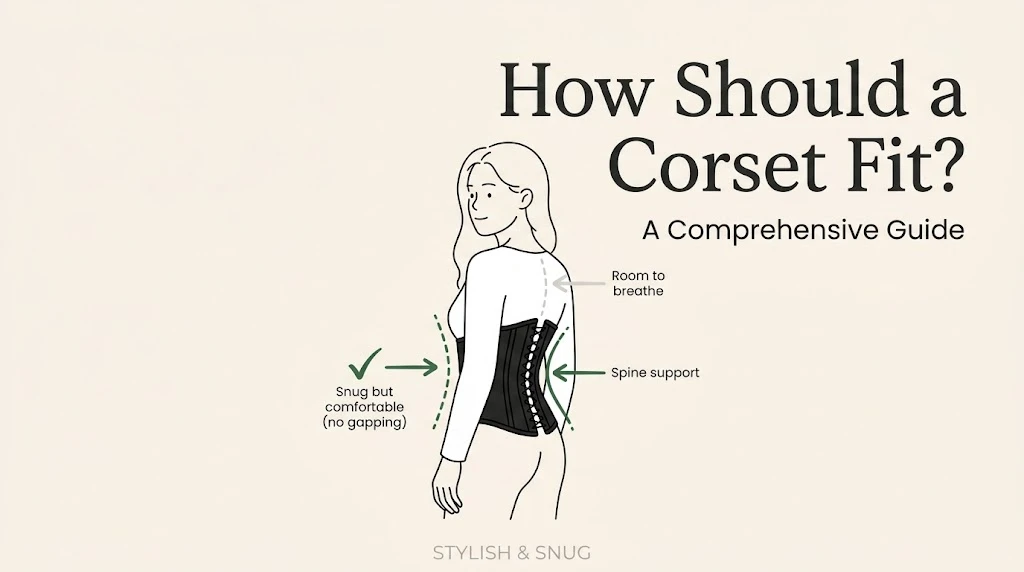
At its core, a properly fitted corset should wrap snug tightly around your waist, hips, and ribcage without causing sharp pain, numbness, or breathing difficulties. It should contour to your natural body curves while applying uniform pressure.
In this comprehensive guide, we will break down the mechanics of corset fit, explore step-by-step measurement techniques, outline the crucial "seasoning" phase, and teach you how to recognize the clear signs of a perfect fit versus a dangerous mis-fit.
💡 Key Takeaway: Comfort Over Compression
A corset is designed to compress your midsection, but it should never hurt. If you feel sharp pain, pinching, or shortness of breath, unlace immediately. A great fit feels like a firm, supportive embrace—not a trap.
1. The Anatomic Anatomy of a Corset Fit
To understand how a corset should fit on your body, you must first understand how its structural components align with your natural anatomy. Corsets do not shrink your entire torso equally; they selectively compress the soft tissue of the midsection while offering structured support around rigid skeletal points.
[ Bust / Underbust Area ] --> Snug, comfortable resting edge
|
====== WAIST TAPE ====== --> Maximum compression line (Natural Waist)
|
[ High Hip / Torso ] --> Flared base, smooth hip transfer
The Three Critical Anchor Zones
- The Natural Waist (The Target Zone): This is the narrowest point of your torso, typically located 1 to 2 inches above your belly button. The corset’s waist tape (the horizontal reinforced strip inside the corset) must align exactly with your natural waist. This is where 90% of the compression occurs.
- The Ribcage / Underbust (The Breathing Zone): The top edge of an underbust corset should sit approximately 0.5 to 1 inch below your breast crease. It should lie flush against your ribs without digging into the bone.
- The Hips (The Anchoring Zone): The bottom edge of the corset flares out to accommodate the hip bones (iliac crest). If the corset is too tight here, it will pin your hip bones; if it is too loose, it will create unwanted gaps under your clothes.
📌 Pro Tip: Locating Your Natural Waist
Stand straight and bend sideways to one direction. The crease that forms on the side of your torso is your natural waist. This is precisely where the narrowest part of your corset must sit.
2. How to Measure Your Body for a Perfect Corset Fit
You cannot guess your corset size based on your standard dress or shirt size. Ready-to-wear clothing relies on stretch fabrics; steel-boned corsets rely on rigid geometry.
To get an accurate fit, take a flexible cloth measuring tape and record these four key body metrics while standing upright with relaxed muscles.
+-------------------+---------------------------------------------------------+
| Measurement Point | How to Measure Accurately |
+-------------------+---------------------------------------------------------+
| 1. Natural Waist | Measure at the narrowest point of your torso. |
| 2. Underbust | Measure directly beneath your bra band/breast crease. |
| 3. High Hip | Measure around the upper crest of your hip bone. |
| 4. Torso Length | Measure sitting down, from underbust to crease of thigh. |
+-------------------+---------------------------------------------------------+
Step-by-Step Measurement Guide
- Natural Waist: Wrap the tape around your waist snugly, but without pulling tightly. Record the number in inches.
- Underbust: Measure directly under your bustline, keeping the tape horizontal and parallel to the floor.
- High Hip: Locate the top of your hip bone and measure around your body at this level.
- Torso Length: Sit upright on a flat chair. Measure vertically from the underbust line down to your lap (where your thigh bends at the hip). Subtract 0.5 to 1 inch to ensure the corset won't dig into your legs when seated.
Selecting Your Corset Size (Waist Reduction)
Corsets are sized by their closed waist measurement in inches. As a general rule:
- Beginners / Fashion Wear: Choose a corset 2 to 4 inches smaller than your natural waist measurement.
- Experienced Wearers / Waist Trainers: Choose a corset 5 to 6 inches smaller than your natural waist measurement.
Example Scenario:
If your natural waist is 30 inches, a beginner should purchase a 26-inch corset. When fully closed, this provides a 4-inch waist reduction.
3. Visual & Physical Indicators of a Good Fit
When putting on a corset for the first time, how do you know if it fits correctly? Look out for these structural and physical indicators.
[CORRECT LACING GAP] [INCORRECT "A" FRAME GAP]
| | (Parallel) \ / (Wider at top)
| | \ /
| | / \ (Wider at bottom)
| | / \
[Even 2-4" Gap] [Improper Tension Distribution]
Visual Signs of a Good Fit
- Parallel Lacing Gap: The back lacing gap should remain parallel from top to bottom (typically 2 to 4 inches wide). The edges should not form an "A-shape" (wider at the top) or a "V-shape" (wider at the bottom).
- Flush Edges: The top edge against your underbust and the bottom edge over your hips should rest flat against your skin without spilling over or gaping wide.
- Smooth Silhouette: Steel boning lines should sit straight vertically along your torso without twisting or bowing sideways.
Physical Signs of a Good Fit
- Firm Compression: Your core feels supported, similar to a deep compression wrap or tight hug.
- Unrestricted Breathing: You can take deep, full breaths into your upper chest without discomfort.
- Mobility: You can sit, stand, and walk comfortably without the steel bones pressing into your thighs or armpits.
4. The Seasoning Process: Breaking In Your Corset
A brand-new steel-boned corset is like a new pair of leather boots: it requires a break-in phase known as seasoning. Seasoning allows the rigid steel boning and high-tensile fabric layers to mold slowly to your body's unique shape.
+---------------+---------------------+---------------------------------------+
| Seasoning Phase| Wear Time per Day | Lacing Tension Level |
+---------------+---------------------+---------------------------------------+
| Days 1 – 3 | 45 to 60 Minutes | Gentle snugness (No waist reduction) |
| Days 4 – 7 | 1 to 2 Hours | Moderate compression (1-2" reduction) |
| Days 8 – 14 | 3 to 4+ Hours | Full target compression |
+---------------+---------------------+---------------------------------------+
How to Season Your Garment Properly
- Do Not Over-Tighten: During the first week, lace the corset just tight enough so it stays anchored. Do not force the corset fully shut.
- Listen to Fabric Creaks: Warmth from your body relaxes the fabric fibers and softens the boning channels over time.
- Inspect the Gaps: Ensure the back gap remains parallel as the corset gradually flexes to match your rib cage and hip contours.
⚠️ Common Pitfall: Cranking the Laces Immediately
Forcing a brand-new corset fully closed on Day 1 can warp the steel bones, tear the stitching at the boning channels, and cause painful pressure points along your ribs. Patience is essential!
5. Troubleshooting Bad Fits & Red Flags
If your corset causes pain, you are dealing with a fit issue—not an inevitable part of corset wearing. Here are the most common signs of a mis-fit and how to fix them:
+---------------------------+-----------------------------------+------------------------------------------+
| Symptom / Warning Sign | Root Cause | Corrective Action |
+---------------------------+-----------------------------------+------------------------------------------+
| Numbness, Tingling, Pain | Nerve compression or over-lacing | Unlace immediately; reduce compression. |
| Digging at the Hips | Hip spring is too small | Choose a model with a larger hip flare. |
| Gaping at the Underbust | Rib spring is too large | Select a corset with a narrower rib flare|
| Pinching at Thighs | Front busk is too long | Choose a shorter torso length option. |
| Pinching Skin at Laces | Missing or folded modesty panel | Flatten modesty panel under lacing gap. |
+---------------------------+-----------------------------------+------------------------------------------+
The "Spring" Ratios Explained
Corsets feature two primary proportion measurements known as Springs:
- Rib Spring: The difference between the closed waist size and the top edge measurement.
- Hip Spring: The difference between the closed waist size and the bottom edge measurement.
If you have a dramatic hourglass shape, a corset with a small hip spring will pinch your hip bones severely. Conversely, if you have an athletic build, a large hip spring will leave gaping openings at the bottom edge. Matching your personal springs to the corset manufacturer's specifications is essential for a proper fit.
Frequently Asked Questions (FAQ)
How tight should a corset be when you first lace it up?
A newly laced corset should feel snug and secure, similar to a firm hug. It should not impede normal breathing or cause sharp pain. During your first few wears, aim for light tension without forcing significant waist reduction.
Is it normal to have a gap in the back of a corset?
Yes! A back lacing gap of 2 to 4 inches is completely normal and desirable. This gap gives you room to tighten the corset as your body adjusts and as the garment seasons over time.
Why is my corset digging into my hips or ribs?
Digging occurs when the corset’s structural proportions do not match your skeletal proportions. This usually indicates that the corset's rib spring or hip spring is too small for your body, or that the front busk length is too long for your torso.
Can I wear a corset comfortably while sitting down?
Yes, provided the corset’s vertical length fits your torso properly. If a corset digs into your thighs or pushes up into your breasts when you sit, the vertical busk length is too long for your seated torso.
Final Thoughts: Finding Your Perfect Silhouette
A well-fitted corset is a harmonious blend of historical engineering, tailoring expertise, and body awareness. By taking precise measurements, paying attention to your torso length, respecting the seasoning process, and prioritizing comfort over extreme compression, you can achieve a stunning silhouette safely and confidently.
 english


 Automotive
 Gifts & Occasions
 Electronics & Computers
 Fashion & Apparel
 Beauty & Personal Care
 Home & Lifestyle
 Sports & Fitness
 Books, Movies & Music
 Baby & Kids